Turn the contract library into a table
A data extractor reads ten contracts into twelve columns: counterparty, payment terms, governing law, liability cap, and more. Each column is defined in plain language.
 NORIKERAll demos
Key terms are extracted into a table, checked against your clause rules, and routed as clear, deviation, or exception.
FinBlade AI · Produced by ICS Nett · Sample data
See this with your own dataFirst-pass contract review is slow and repetitive. A reviewer reads for the same dozen provisions every time. Standard contracts take as long as unusual ones, and the unusual ones are where the risk sits.
Standard contracts clear quickly with a record of every provision and the position taken on it. Reviewers spend their time on the deviations and exceptions. The clause rules are yours, written in plain language.
A data extractor reads ten contracts into twelve columns: counterparty, payment terms, governing law, liability cap, and more. Each column is defined in plain language.
A super agent checks one contract against the rules for its agreement type and reads all thirteen extracted provisions in one pass.
A decision step picks one of three paths: acceptable standard, a deviation to report, or a material exception.
Each path builds its own report and emails the reviewer who needs it.
This Workflow AI use case reviews contracts clause by clause, from the signed agreement to the alert in the reviewer's inbox. It starts with the data extractor reading the contract library as a structured table. 10 sources become 12 columns: the counterparty, the payment terms, the governing law, the liability cap, and the rest. Each column is defined in plain language, like, populate this column with the counterparty. That finished table is what the rest of the review reads from. A contract review query carries the reviewer's question in from the front end. A super agent takes it from there, working from the extracted clauses and the clause library attached to it. Here, it checks contract CLN-1049 against the rules for equipment supply agreements and reads all 13 extracted provisions in one pass. Nothing triggers escalation. Net 30-day payment, 60-day termination, a mutual liability cap, 5-year confidentiality, and price rises capped at 5% a year. The decision node then routes the review down one of 3 paths: an acceptable standard, a deviation to report, or a material exception. Each path builds its own document, converted straight to PDF with the filename, the type, and the margins set on the node. 3 documents: a clearance report, a deviation report, and an exception report, each with its own filename and layout. And each one goes out by email, with the subject, the recipient, and the report attached. And 3 notifications to match, each addressed to the reviewer who needs it. The clearance report comes out as a working document, every provision listed with the position taken on it. One contract in, and the right review, the right record, and the right notification out.
Company names, people, and figures in these demos are illustrative. Your configuration, data access, and deployment are defined during scoping.
 0:51
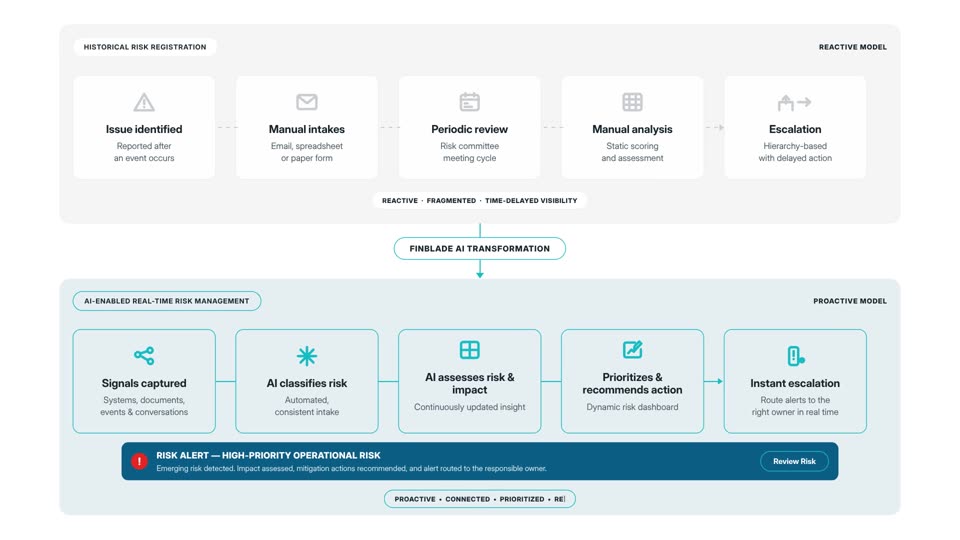
A 51-second look at moving risk work from after the event to the moment a signal appears.
Explore this demo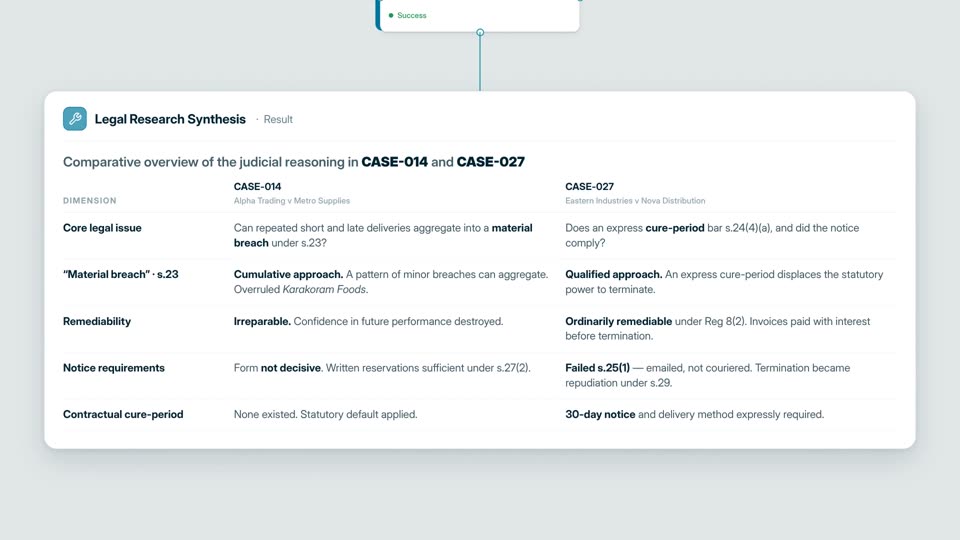 1:32
The assistant reads the act, the regulations, and both judgments, then compares the reasoning with section numbers.
Explore this demo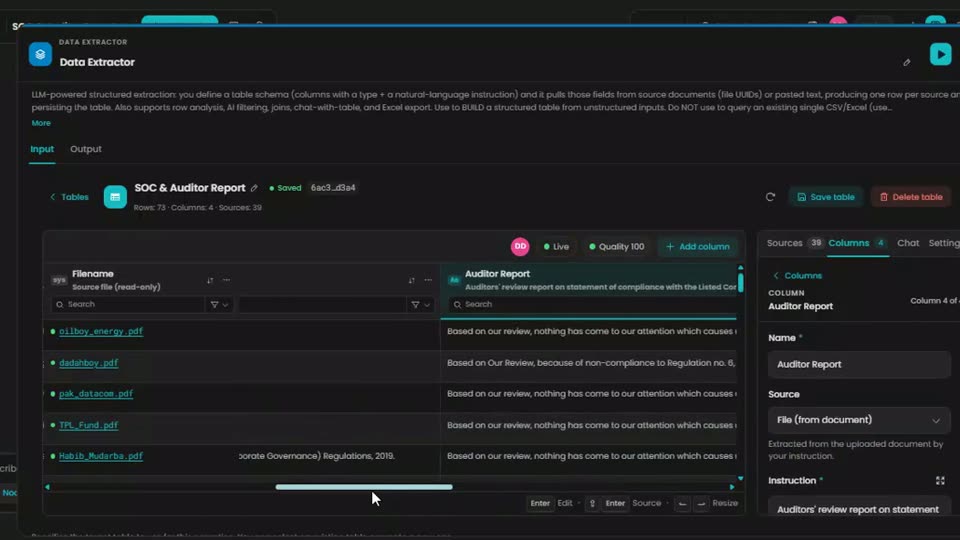 2:22
One step pulls the same fields from every filing into a single table. Each row links back to its source.
Explore this demo